
A Living Work of Botanical Art for Terrariums, Paludariums & Rare Plant Collections
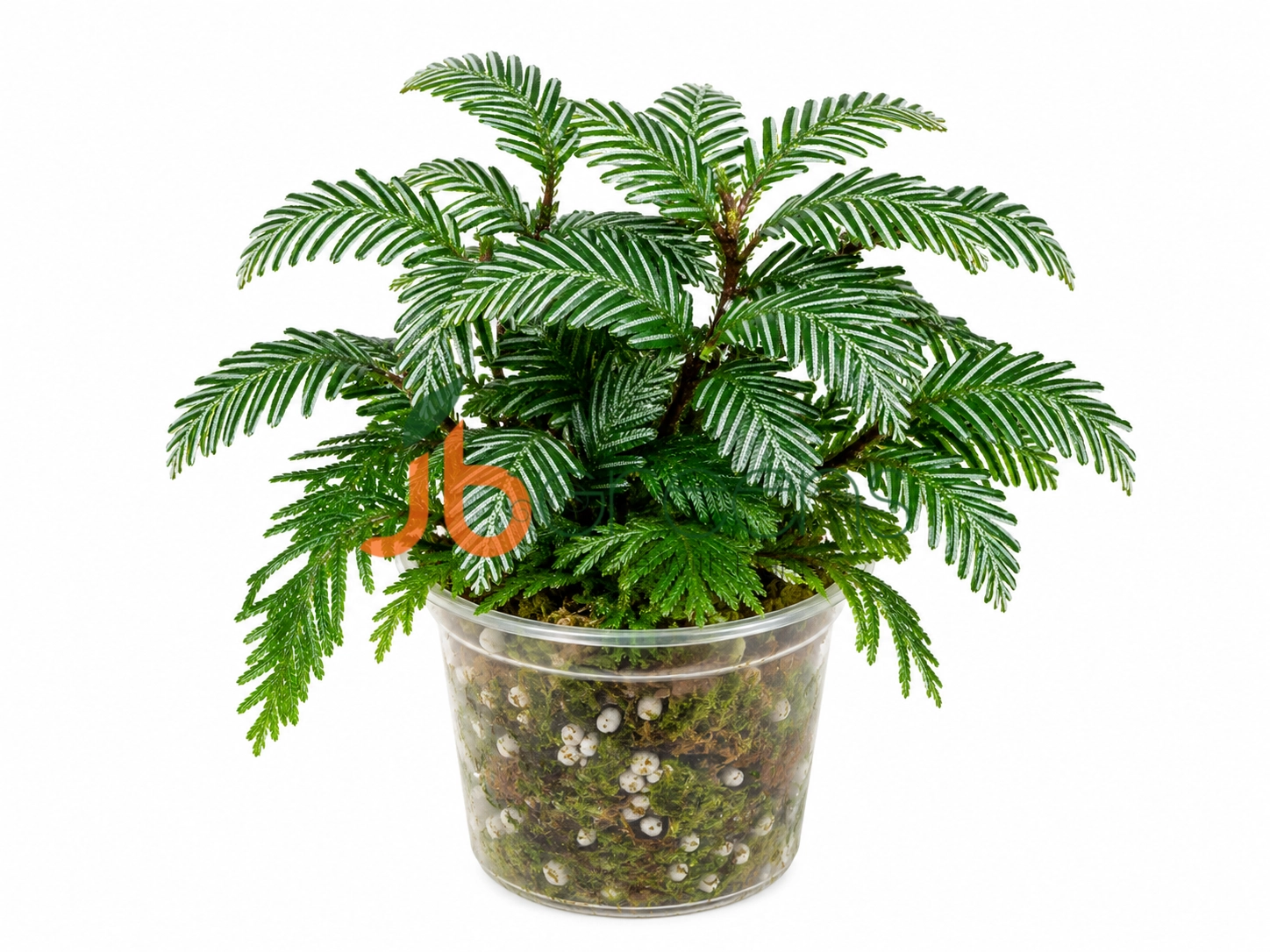
Bring the quiet magic of Asian rainforest floors into your glass garden with Selaginella picta—affectionately known as the Painted Spikemoss. True to its Latin species name picta (meaning “painted”), this rare fern ally unfurls delicate, emerald-green fronds brushed with striking silvery-white to pale lime-green central bands.
Unlike ordinary green mosses or ferns, Selaginella picta adds instant contrast, feathery texture, and a wild, ancient-forest feel to enclosed ecosystems. Grown and acclimated with care at our Bengaluru nursery, it’s a collector’s centerpiece that turns any terrarium or paludarium into a miniature tropical masterpiece.
Botanical Profile & History
-
Scientific Name: Selaginella picta (Griff.) A. Braun ex Baker
-
Common Name: Painted Spikemoss
-
Family: Selaginellaceae (the Spikemoss or Lesser Clubmoss family)
-
Plant Type: Evergreen perennial lycophyte (an ancient, non-flowering vascular “fern ally”—neither a true moss nor a true fern)
-
Pet & Vivarium Safety: Generally considered non-toxic and safe for pet-friendly homes and bioactive vivariums
Who Discovered & Named Selaginella picta?
The original botanical specimens of Selaginella picta were first collected in India by the renowned British physician and botanist William Griffith (who initially catalogued it under the name Lycopodium pictum). The German botanist Alexander Braun later recognized its true placement in the genus Selaginella, and the British botanist John Gilbert Baker formally published the name Selaginella picta in the Journal of Botany in 1885. (In 2023, modern phylogenetic studies also noted the synonym Didiclis picta.)
Native Habitat & Where It Is Found
In the wild, Selaginella picta inhabits the shaded, misty floors of dense tropical and subtropical forests at elevations of 400 to 1,000 meters (occasionally up to 1,800 meters). Its native range spans Northeast India (Assam), Southern China (Yunnan, Guangxi, Hainan, Jiangxi, and Xizang), and Southeast Asia (Myanmar, Thailand, Laos, Cambodia, and Vietnam).
Speciality, Key Features & Lifespan
What Makes It Special?
-
Natural Structural Variegation: Unlike unstable variegated houseplants that can revert to plain green, the silvery-white and lime markings on Selaginella picta are caused by structural variegation—tiny intercellular air spaces inside the leaf tissue that reflect light. That means its hand-painted pattern is built right into the plant’s biology.
-
Ancient Living Lineage: Spikemosses belong to one of the oldest vascular plant lineages on Earth, reproducing by spores in the wild rather than flowers or seeds.
Life & Growth Habit
Selaginella picta is a long-lived, evergreen perennial. With steady humidity and occasional division, it thrives indefinitely. It grows from a creeping, reclining (decumbent) base into graceful, ascending, fern-like sprays. While wild specimens can reach 35–55 cm tall in deep jungle habitats, indoor and terrarium-grown plants stay a refined, manageable 10–25 cm, spreading at a moderate pace into a lush, layered carpet.
How to Identify Selaginella picta
-
Painted Central Bands: Deep green fronds highlighted by unmistakable pale lime-green to silvery-white longitudinal patches down the center of the foliage.
-
Dimorphic Scale-Like Leaves: Tiny, flat, overlapping leaves (microphylls) arranged neatly along slender, flattened branching stems—with larger leaves flanking the sides and smaller leaves nestled along the middle.
-
Basal Rhizophores: Stems rise from a decumbent base without true underground creeping rhizomes; thin, root-bearing supports (rhizophores) appear only on the lower portion of the stem.
Complete Care Guide
Lighting Requirements
Provide bright, indirect, or filtered light—or gentle, full-spectrum LED grow lights in enclosed glass setups. Avoid harsh direct sunlight, which quickly scorches the delicate fronds and fades the painted contrast. Very dim light slows growth and makes the stems stretch and thin out.
Watering Requirements
Selaginella picta loves consistent, even moisture. Keep the substrate lightly damp at all times, never allowing the root ball to dry out completely (drought causes foliage to turn crisp and brown almost overnight). At the same time, avoid soggy, waterlogged soil or standing water, which can cause stems to yellow and collapse. Use filtered, RO, or rainwater whenever possible.
Humidity & Temperature
-
Humidity: High humidity is non-negotiable. Aim for 75%–90% humidity for lush, vigorous growth (60% minimum). Enclosed terrariums, plant cabinets, or paludariums are the easiest ways to maintain this.
-
Temperature: Thrives in warm, steady tropical temperatures between 18°C and 28°C. Keep it away from cold drafts, AC vents, and dry heaters.
Potting & Ideal Substrate (JB Greens Recommendation)
Selaginella picta has a fine, shallow root system that needs a loose, airy, moisture-retentive, yet well-draining organic mix.
-
Recommended Media: Plant in our Fern Potting Mix by JB Greens (crafted specifically for moisture-loving ferns and fern allies) or Aroids Potting Mix by JB Greens (pH-optimized at 5.8–6.5 with balanced aeration and slow-release organic nutrition) — available at www.jbgreens.com.
-
Drainage Tip: Always add a 2 cm drainage layer (LECA or fine gravel) at the bottom of closed terrariums or pots to keep excess water away from the roots.




Reviews
There are no reviews yet.