
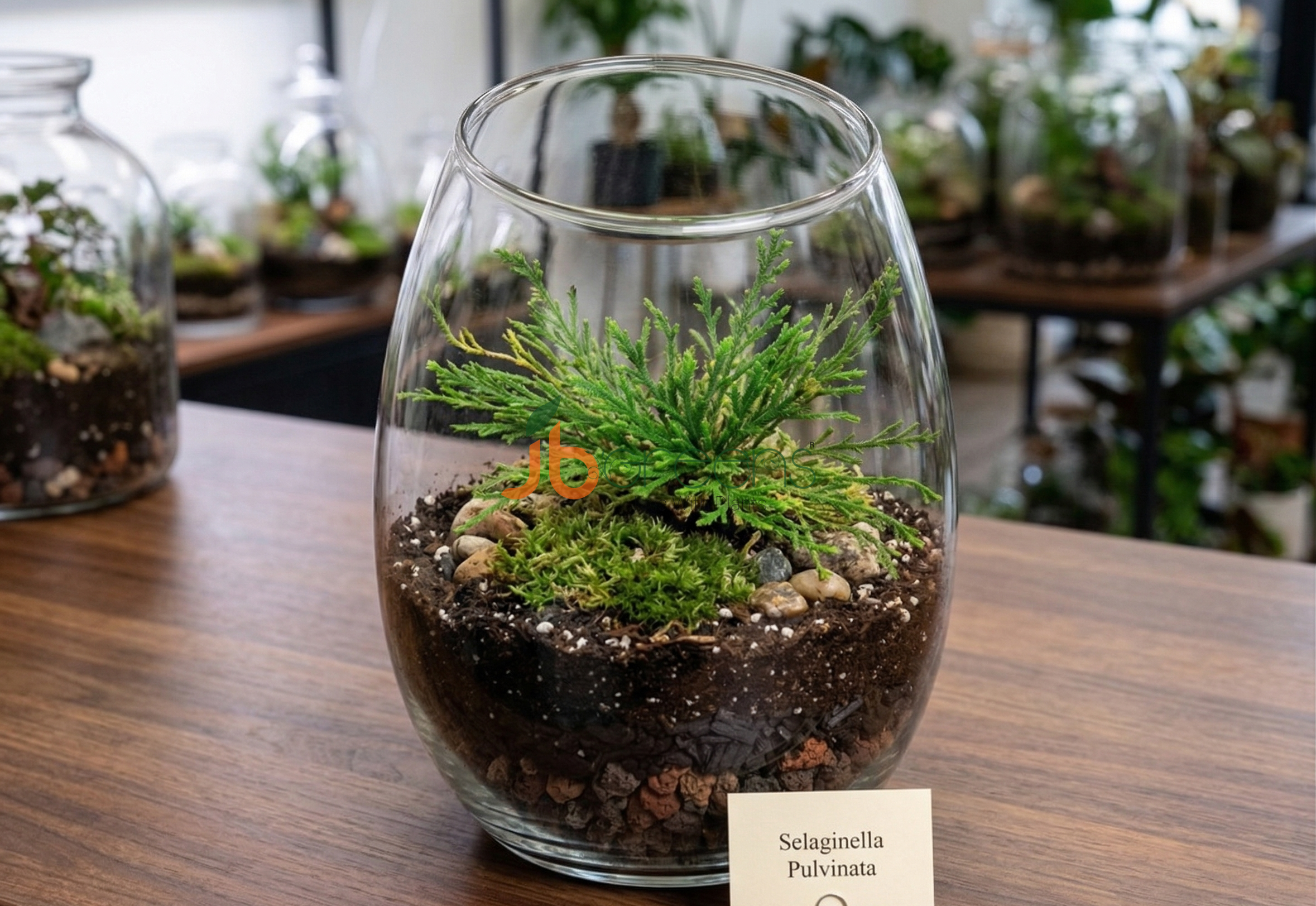
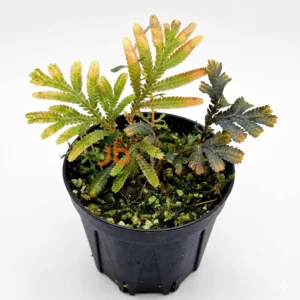
Bring home a living botanical marvel. Selaginella pulvinata is an extraordinary, ancient fern-ally celebrated for its sculptural, emerald-green rosette and its astonishing “resurrection” ability. Compact, architectural, and brimming with prehistoric charm, this rare spikemoss transforms glass terrariums, misty paludariums, and miniature rockscapes into lush, living ecosystems.
Curated and acclimated at our Bengaluru nursery, Selaginella pulvinata is a must-have collector’s specimen for hobbyists who appreciate rare textures, natural resilience, and refined foliage geometry.
Botanical Profile & Heritage
-
Scientific Name: Selaginella pulvinata (Hook. & Grev.) Maxim.
-
Common Names: Cushion Spikemoss, Asian Resurrection Spikemoss, Cushion Clubmoss (Dian Zhuang Juan Bai in China; Dok Hin in Thailand)
-
Family: Selaginellaceae (the Spikemoss family) — despite the name “spikemoss,” it is not a true moss. It is an ancient vascular plant belonging to the lycophytes (fern allies), featuring true vascular tissue and reproducing via spores.
-
Who Discovered & Named It: The original type specimen was collected by the renowned botanist Dr. Nathaniel Wallich. In 1831, Scottish botanists Sir William Jackson Hooker and Robert Kaye Greville first formally described it as Lycopodium pulvinatum. Later, in 1859, Russian botanist Carl Johann Maximowicz reclassified it into the genus Selaginella, establishing its accepted name, Selaginella pulvinata (Hook. & Grev.) Maxim..
-
Where It Is Normally Found (Native Habitat): Selaginella pulvinata is native across East, South, and Southeast Asia—including Northern India (Uttarakhand), Nepal, China, Thailand, Vietnam, Korea, Mongolia, and Siberia. In the wild, it grows as a terrestrial or epilithic (rock-dwelling) plant nestled in limestone crevices and rocky mountain slopes at altitudes ranging from 1,000 m to over 4,000 m.
Speciality & Standout Features
-
The “Resurrection” Phenomenon: Selaginella pulvinata is a xerophytic, poikilohydric plant. When exposed to prolonged dryness in nature, its fronds curl tightly inward into a dense, protective ball to conserve moisture. Once rehydrated, it dramatically unfurls back into a radiant green rosette. (In home setups, keeping steady moisture ensures it stays lush and open year-round.)
-
Sculptural Cushion Rosette: Its flat, radially symmetrical foliage spreads in layered, feather-like fans, creating a soft, miniature fern-like cushion that typically stays compact at 2–15 cm (occasionally up to 20 cm).
-
Pet-Safe & Ancient Lineage: As a non-toxic lycophyte from a lineage dating back hundreds of millions of years, it adds safe, living history to indoor plant collections.
Life Cycle & Growth Habit
Selaginella pulvinata is a slow-to-moderate growing, long-lived perennial evergreen herb (seasonally green in harsh wild climates). Unlike flowering plants, it does not produce seeds or flowers. Instead, it reproduces via two types of spores (megaspores and microspores) housed in tiny, compact, four-sided spore cones called strobili at the tips of mature branches.
In cultivation, it grows steadily from a dense central rootstock without invasive creeping runners, making it exceptionally well-behaved in confined glass enclosures.
How to Identify Selaginella pulvinata
Because several rosette-forming spikemosses look similar at a glance, here are the key botanical identification traits of true Selaginella pulvinata:
-
Basal Rosette Without Creeping Rhizomes: Multiple main stems branch right from the base atop a thick, fibrous rootstock—forming a tight, cushion-like rosette without underground creeping rhizomes.
-
Distinguishing from Selaginella tamariscina: Unlike S. tamariscina, S. pulvinata generally lacks a tall, woody above-ground “pseudotrunk” and does not have prominent ridges on its dorsal leaves.
-
Distinguishing from Selaginella bryopteris: While S. bryopteris branches higher up near the middle of its stems, S. pulvinata branches directly near and above the base into a classic flat rosette.
-
Dimorphic, Overlapping Leaves: Under close inspection, its tiny scale-like leaves come in two sizes (dimorphic), tightly overlapping (imbricate) along pinnately forked branches. The ventral leaves are ovate with finely toothed (lacerate) margins and pointed (acuminate) tips.
-
Tetragonal Strobili: Mature tips produce solitary, compact, four-angled (tetragonal) spore cones measuring roughly 7–20 mm long.
Complete Care Guide
1. Lighting Requirements
-
Ideal: Bright, indirect light or soft, filtered LED grow lights (6,500K full-spectrum works wonderfully for terrariums).
-
Avoid: Harsh, direct afternoon sunlight, which scorches delicate fronds and overheats enclosed glass jars. Too little light leads to pale, stretched, and leggy growth.
2. Watering
-
Keep the growing medium consistently moist, never waterlogged.
-
Use filtered, rainwater, or RO water, as spikemosses are sensitive to heavy mineral buildup and chlorine.
-
While S. pulvinata can survive brief dry spells by curling inward, repeated drying cycles stress the plant. Aim for steady, gentle hydration.
3. Humidity & Temperature
-
Humidity: Thrives in 65%–90% relative humidity. While more forgiving than ultra-delicate rainforest Selaginella species, high humidity keeps the fronds vibrant, flat, and lush.
-
Temperature: Ideal indoor range is 18°C–28°C (though it naturally tolerates a wide temperature spectrum). Keep away from dry AC drafts or hot vents.
4. Potting & Ideal Growing Media
Because Selaginella pulvinata naturally grows in rocky crevices with fibrous roots, it demands a fine, moisture-retentive yet airy and well-draining substrate that prevents stagnant water around the rootstock.
-
Recommended Media: Plant directly into Fern Potting Mix by JB Greens — specially formulated with a fine, friable texture for delicate rhizomes, fibrous roots, and high-humidity terrarium environments. For open pots or rocky epilithic mounts requiring extra drainage, you can blend in a small portion of Aroids Potting Mix by JB Greens or fine lava rock.
-
Always include a 2 cm drainage layer (LECA or fine gravel) at the base of closed containers or pots.
5. Nutrient Requirements & JB Greens Tonic Protocol
Selaginella species are light feeders and easily burned by harsh chemical fertilizers. Gentle, organic, or homeopathic nutrition produces the best long-term vigor.
-
With JB Greens Homeopathic Plant Tonics (Dosage: 0.5 ml per 1 litre of clean water, applied weekly in rotation as a gentle mist or soil drench):
-
Root Establishment & Soil Vitality: Use Rhizara (Root Growth Booster) and Soilora (Soil Enhancer) during the first 2–4 weeks after potting to build strong fibrous roots and active substrate microbes.
-
Lush Foliage Growth: Apply Vigora (Growth Stimulant) to encourage dense, bright green rosette expansion.
-
High-Humidity Defense: In closed terrariums, rotate Fungara (Fungal Defense Support) to guard against fungal stress, and Pastara for natural insect resilience.
-
Travel & Stress Recovery: If your plant curls up during transit or acclimation, a gentle misting with Restora (Plant Regenerator) helps revive vitality rapidly.
-
Tip: Get all six tonics in the JB Greens Complete Homeopathic Tonic Combo (6 x 30 ml) for a full, balanced weekly care routine.
-
6. Repotting
-
Repot every 18–24 months (ideally in spring or early monsoon) or only when the rootstock outgrows its container.
-
Choose a shallow, wide pot or terrarium pocket just 2–4 cm larger than the root mass.
-
Handle the basal rootstock gently, keep the crown level with the substrate surface (never bury the center of the rosette), and water lightly with Rhizara + Restora to eliminate transplant shock.
Uses in Terrarium & Paludarium Setups
Selaginella pulvinata is a dream centerpiece for naturalistic scaping:
-
Closed & Semi-Closed Terrariums: Its compact rosette habit makes it an ideal foreground or midground focal point. Unlike fast-creeping mosses that overtake a jar, S. pulvinata holds a neat, architectural form that pairs beautifully with pillow moss, miniature ferns, Fittonia, and Marcgravia.
-
Paludariums & Ripariums: Place it in the emergent land zone or nestled into damp hardscape crevices (such as dragon stone, lava rock, or driftwood) above the waterline. It loves the constant ambient mist rising from waterfalls and water features—just ensure its rootstock is not permanently submerged underwater.
-
Wabi-Kusa & Rock Scapes: Because it is naturally epilithic, it thrives when anchored into moss-lined crevices on porous stones, recreating an authentic miniature Himalayan cliffside.




Reviews
There are no reviews yet.