
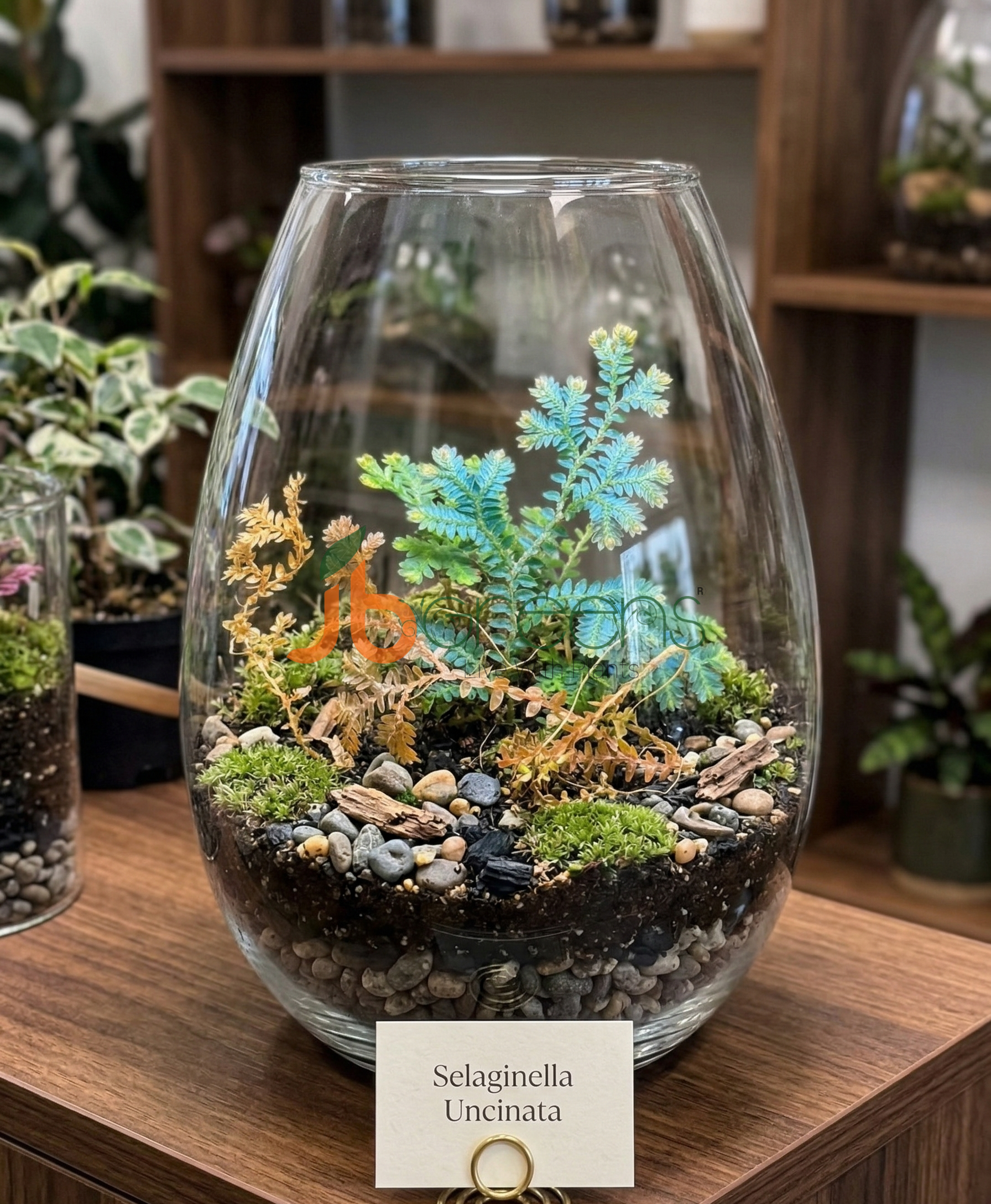
A Living Jewel of the Shaded Rainforest Floor
Bring an otherworldly, electric-blue shimmer to your indoor jungle with Selaginella uncinata—affectionately known as Peacock Moss, Rainbow Moss, or Blue Spikemoss. Celebrated by terrarium artists and rare plant collectors worldwide, this mesmerizing creeping groundcover transforms dim, humid corners into a glowing tapestry of metallic turquoise, sapphire, and emerald green.
Conventionally and organically grown at our JB Greens Bengaluru nursery, every Selaginella uncinata is rooted, acclimated, and nurtured by our growers—never tissue-cultured—so it arrives healthy and ready to thrive in your living world.
Botanical Profile & Quick Care Snapshot
| Feature | Details |
| Botanical Name | Selaginella uncinata (Desv. ex Poir.) Spring |
| Common Names | Peacock Moss, Rainbow Moss, Blue Spikemoss, Spring Blue Spikemoss |
| Family | Selaginellaceae (Spikemoss / Lycophyte family) |
| Native Habitat | Shaded subtropical & tropical forest floors of Southern China |
| Light | Low to medium indirect light (shade intensifies the blue iridescence) |
| Humidity | High (70% – 95%+) — ideal for closed terrariums & paludariums |
| Watering | Consistently moist; never allow to dry out completely |
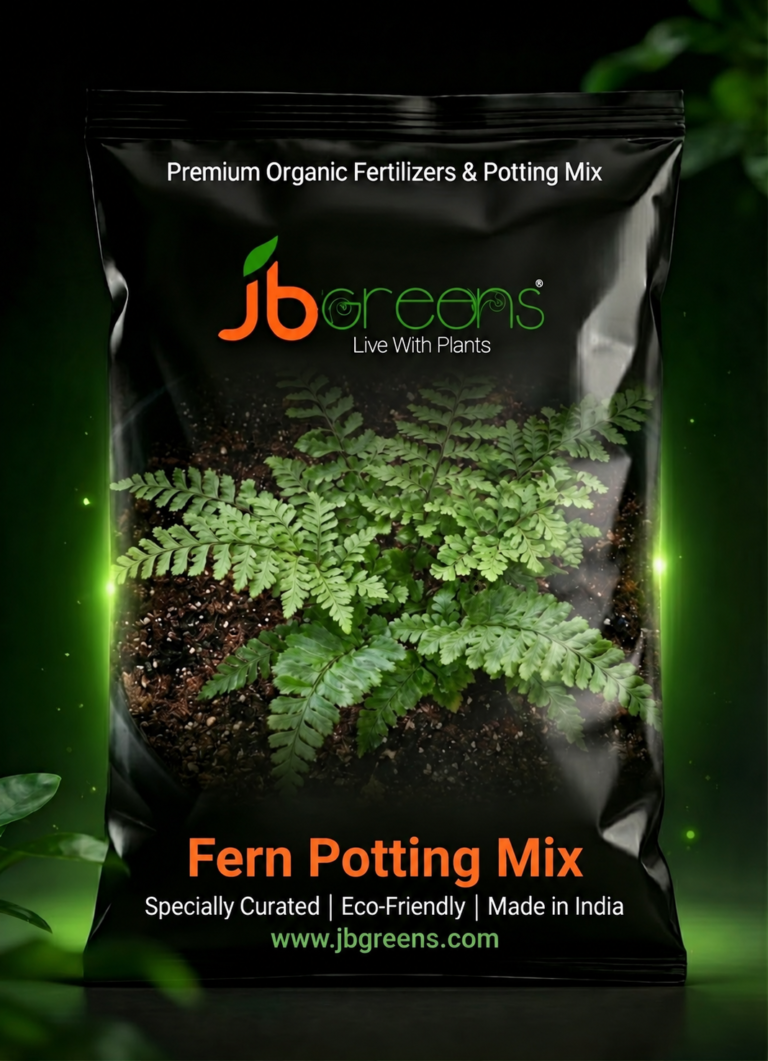
| Recommended Media | Fern Potting Mix by JB Greens |
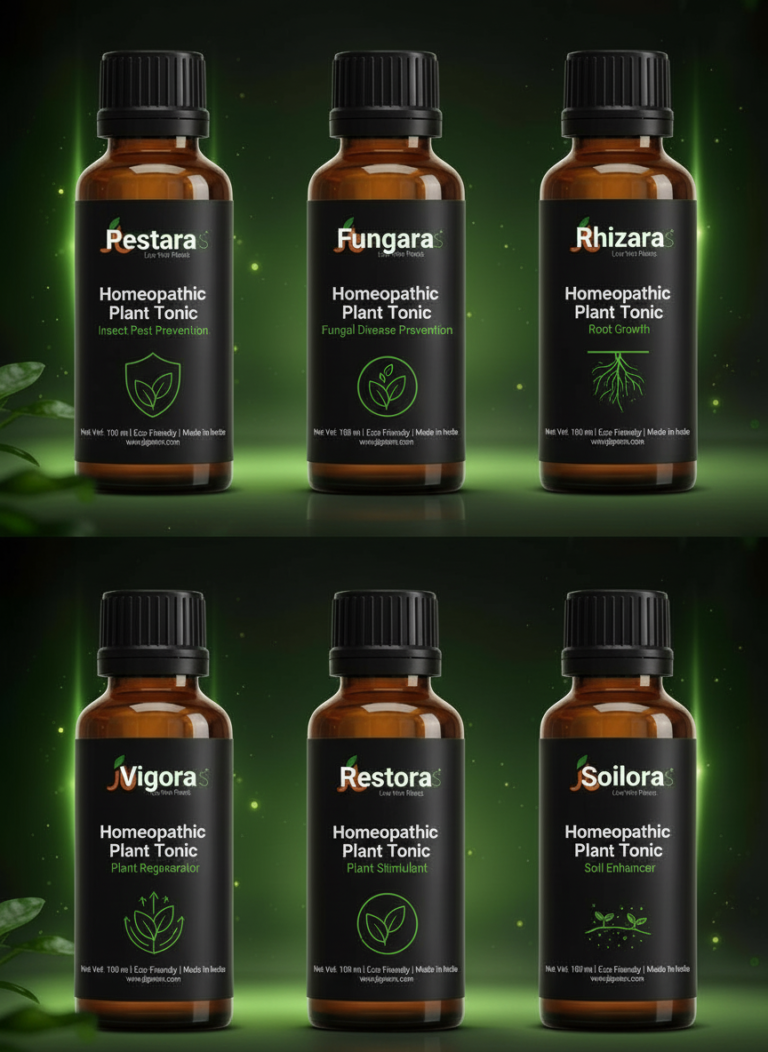
| Recommended Tonics | JB Greens Homeopathic Plant Tonics (Rhizara, Soilora, Vigora, Restora) |
Family, History & Who Discovered It
Despite its common names, Selaginella uncinata is neither a true moss nor a true fern. It belongs to the ancient family Selaginellaceae, a lineage of seedless vascular plants known as lycophytes (or fern allies) whose ancestors dominated the Earth over 300 million years ago.
-
Discovery & Naming: The species was first scientifically described in 1814 as Lycopodium uncinatum by the French botanist Nicaise Auguste Desvaux (published by Jean Louis Marie Poiret, hence the citation Desv. ex Poir.). In 1843, the Belgian-German botanist Antoine Frédéric Spring reclassified it into the genus Selaginella, giving us its accepted botanical name: Selaginella uncinata (Desv. ex Poir.) Spring.
-
Meaning of the Name: The species epithet uncinata derives from the Latin word for “hooked,” referring to the delicate, slightly curved tips of its tiny scale-like leaves.
Natural Habitat: Where It Is Normally Found
Selaginella uncinata is native to southern China, where it carpets damp, heavily shaded forest floors, mossy limestone rocks, stream banks, and humid ravines beneath dense rainforest canopies. Because of its ornamental appeal and vigor in humid subtropical climates, it is also widely cultivated outdoors in warm, humid regions such as the U.S. Gulf Coast and in specialty conservatories worldwide.
Speciality & Key Features: The Science Behind the Blue Glow
What makes Selaginella uncinata one of the most sought-after terrarium plants on Earth is its breathtaking iridescent blue sheen.
-
Structural Coloration (No Blue Pigment!): Unlike blue flowers that rely on anthocyanin pigments, the metallic blue of S. uncinata is a rare optical phenomenon called thin-film interference—the same physical effect seen on morpho butterfly wings and jewel beetles. Specialized microscopic cellulose layers within its convex, lens-shaped upper epidermal cells reflect blue wavelengths of light while helping the plant capture usable light in the dim forest understory.
-
Color-Shifting Foliage: Depending on your lighting, the plant acts like a living mood ring—glowing electric peacock-blue in low, shaded light, shifting to vibrant emerald in brighter indirect light, and developing copper, bronze, or rosy-pink blushes under higher light exposure.
Life Cycle & Growth Habit
As a perennial seedless vascular plant, Selaginella uncinata does not produce flowers or seeds. Instead, it has a heterosporous life cycle, producing two distinct types of spores (megaspores and microspores) inside tiny, four-angled, cone-like structures called strobili at the tips of mature branches.
In cultivation, it spreads effortlessly through creeping, trailing, dichotomously branching stems (which can trail up to 60 cm). Along the stem nodes, it sends down slender, wiry rhizophores (root-bearing structures) that anchor into moist moss, wood, or soil, creating a lush, dense mat.
How to Identify Selaginella uncinata
Collectors often confuse S. uncinata with other spikemosses like Selaginella willdenowii (Peacock Fern) or Selaginella kraussiana. Look for these signature identification markers:
-
Trailing, Low-Growing Habit: Unlike S. willdenowii (which grows tall, upright, or climbing frond-like stems), S. uncinata is a low-lying, sprawling groundcover with flat, lacy sprays.
-
Dimorphic, 4-Ranked Leaves: Look closely at the stems—you will see two different sizes of tiny, overlapping leaves arranged in four neat rows (larger lateral leaves flanking smaller median leaves along the upper side).
-
Pale Straw-Colored Stems: Its slender, creeping stems are typically pale greenish-white to straw-colored, contrasting beautifully against the blue-green foliage.
-
Two-Toned Leaf Surfaces: The upper (adaxial) leaf surface shows the signature iridescent blue-green sheen, while the underside (abaxial) remains a matte, pale green.
-
Four-Angled Strobili: Mature tips occasionally form narrow, four-sided spore cones up to 2 cm long.
Complete Care Guide
1. Lighting Requirements (The Secret to Maximum Blue)
-
Ideal Light: Low to medium indirect light, or soft, diffused LED terrarium lighting.
-
Pro Tip: Less light equals more blue! In bright light, the iridescence fades into plain green, yellow, or bronze. Direct sunlight will quickly scorch its delicate microphylls. Place it in a shaded spot or beneath taller canopy plants in your terrarium for that coveted metallic sapphire glow.
2. Watering Requirements
-
Keep the substrate evenly and consistently moist, like a wrung-out sponge. Never allow the root zone to dry out completely, as Selaginella foliage crisps rapidly when dehydrated.
-
Avoid stagnant, waterlogged soil to prevent stem rot.
-
Water Quality: Use rainwater, RO water, or filtered water whenever possible. Hard tap water can leave mineral deposits on the leaves that dull their iridescent sheen.
3. Humidity Requirements
-
Thrives in 70% to 95%+ relative humidity.
-
While it can grow in open pots in naturally humid climates, it performs at its absolute best inside closed terrariums, Wardian cases, cloches, paludariums, or humid greenhouses.
4. Potting & Ideal Growing Media
Selaginella uncinata has fine, shallow, fibrous roots that require a moisture-retentive yet breathable, fine-textured medium.
-
JB Greens Recommendation: Pot directly into Fern Potting Mix by JB Greens. Specially formulated with a fine, friable texture for delicate rhizomes and fibrous roots, it delivers optimal moisture retention, gentle aeration, and high-humidity stability tailored for terrariums, vivariums, and Wardian cases.
-
For closed terrariums, always add a 2–3 cm drainage layer (LECA or fine gravel) beneath the mix.




Reviews
There are no reviews yet.