
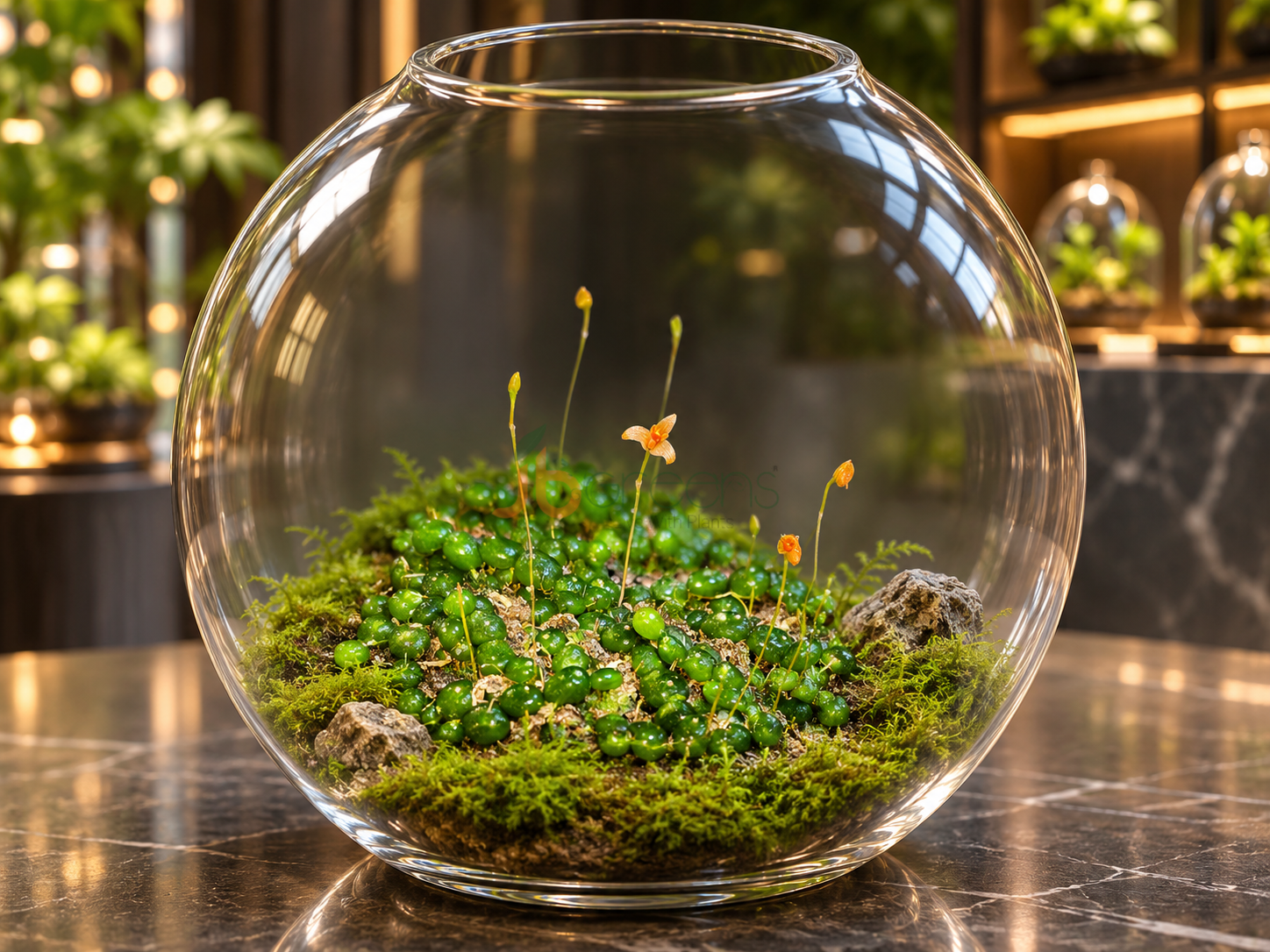
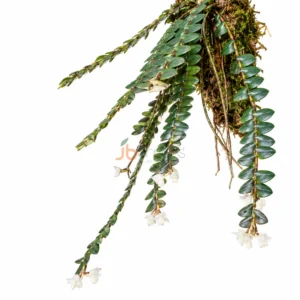
A living jewel for miniature orchid collectors and terrarium enthusiasts, Bulbophyllum moniliforme is celebrated for its unmistakable, bead-like pseudobulbs that creep across bark and moss like a delicate string of green pearls. Compact, resilient, and endlessly fascinating under close inspection, this rare Southeast Asian epiphyte brings an authentic touch of the rainforest canopy right into your indoor collection.
Botanical Profile & Quick Reference
| Attribute | Details |
| Botanical Name | Bulbophyllum moniliforme |
| Family | Orchidaceae (Orchid Family) |
| Growth Habit | Miniature, creeping, epiphytic perennial |
| Native Habitat | Southeast Asia (Myanmar, Thailand, Laos, Cambodia, Vietnam, and Peninsular Malaysia) |
| Light | Bright, indirect light to dappled shade |
| Humidity | High (65% – 85%+) |
| Watering | Frequent misting; keep evenly moist, never soggy |
| Ideal Setup | Terrariums, paludariums, orchidariums, or mounted on cork/wood |
Discovery & Naming History
Bulbophyllum moniliforme was first discovered and formally described in 1874 by Charles Samuel Pollock Parish (a British missionary and prolific botanist stationed in Myanmar) and Heinrich Gustav Reichenbach (one of the 19th century’s foremost orchidologists).
The species epithet moniliforme is derived from the Latin monile (necklace) and forma (shape), directly referencing its signature chains of tiny, rounded pseudobulbs that resemble a beaded necklace.
Natural Habitat & Life Cycle
In the wild, Bulbophyllum moniliforme grows as an epiphyte perched high on mossy tree trunks and branches in lowland to mid-elevation tropical rainforests (typically from sea level up to 1,000 meters).
-
Life Cycle: It is a long-lived perennial that spreads steadily via a slender, creeping rhizome. During the dry season in its native habitat, it may shed its tiny leaves while relying on the water stored in its plump pseudobulbs, quickly flushing with fresh growth and miniature blooms when moisture returns.
Key Features, Speciality & Identification
What makes Bulbophyllum moniliforme a prized collector’s piece is its extreme miniaturization and architectural charm:
-
Bead-Like Pseudobulbs: The easiest way to identify this species is its clusters of tiny, ovoid-to-spherical pseudobulbs (roughly 3–6 mm wide) arranged tightly along a creeping rhizome, forming a dense, mat-like “necklace” of green beads.
-
Foliage: Each pseudobulb produces a single, miniature, fleshy, elliptic-to-oblong leaf (often under 1–2 cm long) that may be deciduous depending on seasonal conditions.
-
Flowers: Blooms appear individually from the base of the pseudobulbs on hair-thin stalks. Though tiny (around 4–6 mm), the flowers are striking under a magnifying glass—featuring vibrant amber, orange-yellow, or reddish-brown sepals with darker veins and a hinged, mobile lip typical of the Bulbophyllum genus.
-
Speciality: Unlike many larger orchids that require significant shelf space, B. moniliforme thrives in micro-environments and naturally hugs contours of driftwood, stone, and mossy backgrounds.
Terrarium & Paludarium Applications
Bulbophyllum moniliforme is one of the finest botanical accents available for bioactive enclosures:
-
Terrariums: Mount it on elevated cork bark, cholla wood, or lava rock above the substrate line. Its slow, creeping habit ensures it will not overrun delicate mosses or companion micro-ferns.
-
Paludariums: Ideal for the humid, emergent upper zones above the waterline. The ambient evaporation from the water feature naturally satisfies its high humidity needs while keeping its roots safely out of standing water.
Complete Care Guide
Lighting Requirements
Provide bright, indirect light or dappled shade (similar to a filtered forest canopy). Under artificial grow lights in a terrarium or paludarium, place it in the mid-to-upper zone under full-spectrum LEDs for 10–12 hours daily. Avoid harsh, direct afternoon sun, which can scorch the tiny pseudobulbs.
Watering
Because it lacks large water-storing leaves, B. moniliforme prefers consistent moisture with rapid air circulation. Mist thoroughly once a day (or every other day in enclosed setups) using rainwater, distilled water, or RO water. Allow excess water to drain off the pseudobulbs so they do not sit in stagnant pools.
Humidity & Airflow
Maintain 65% to 85%+ relative humidity. Good air movement is just as important as high humidity—gentle ventilation prevents fungal issues and mimics the breezy treetops of its native habitat.
Potting & Mounting Media
This orchid thrives best mounted on cork bark, tree fern plaques, or driftwood with a thin layer of sphagnum moss around the roots. If you prefer growing it in a shallow pot or net basket, use an ultra-airy, fast-draining epiphytic mix.
Recommended Media: For optimal root aeration and healthy rhizome spread, pair your Bulbophyllum moniliforme with our specialized, pre-sterilized epiphytic potting media available at www.jbgreens.com, formulated specifically to balance moisture retention and airflow.
Nutrient Requirements
As a miniature epiphyte, B. moniliforme is a light feeder. Over-fertilizing can burn its delicate roots. Feed weakly (“weakly, weekly”) at 1/4 strength during active growth periods, and flush with plain water once a month to prevent mineral buildup.
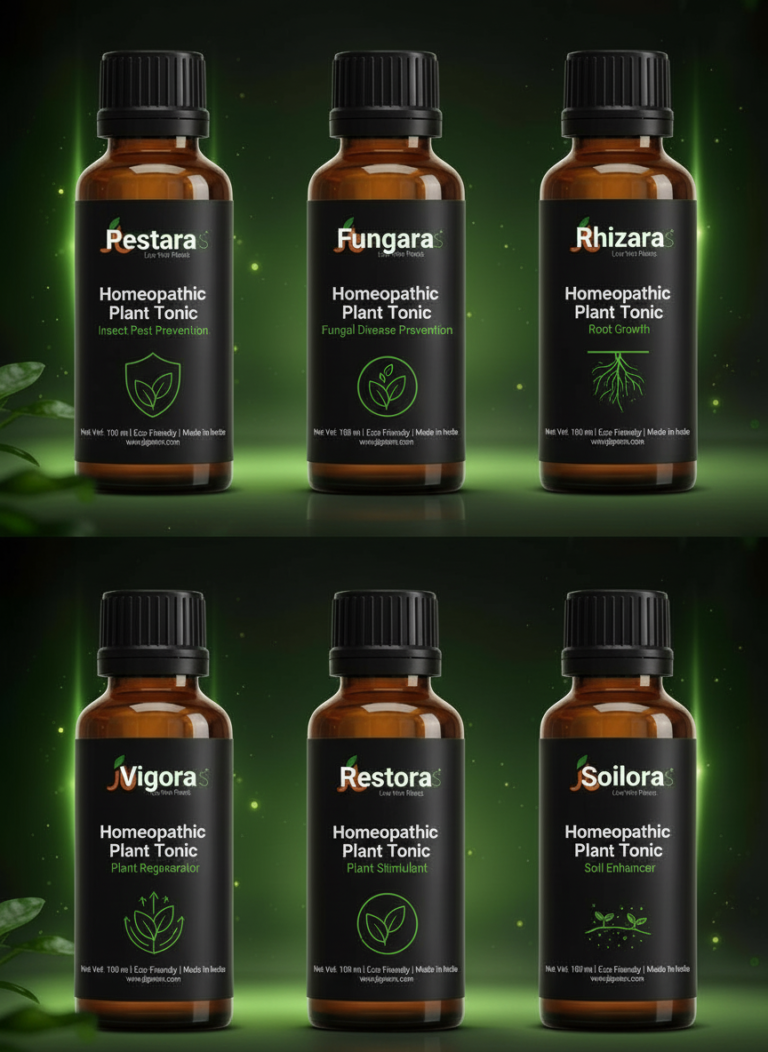
Recommended Nutrition: Boost pseudobulb plumpness, root vigor, and blooming potential with our gentle, bio-available plant tonics available at www.jbgreens.com. Diluted as directed, our tonics provide essential micronutrients tailored for sensitive orchids and terrarium flora.
Repotting & Remounting
Bulbophyllum moniliforme dislikes frequent root disturbance. Repot or remount only every 2 to 3 years, or when the moss/bark medium begins to break down. The best time to remount is just as new green root tips appear along the rhizome. Gently secure the creeping mat onto fresh bark or media using fishing line or soft cotton thread until the new roots anchor themselves naturally.



Reviews
There are no reviews yet.