
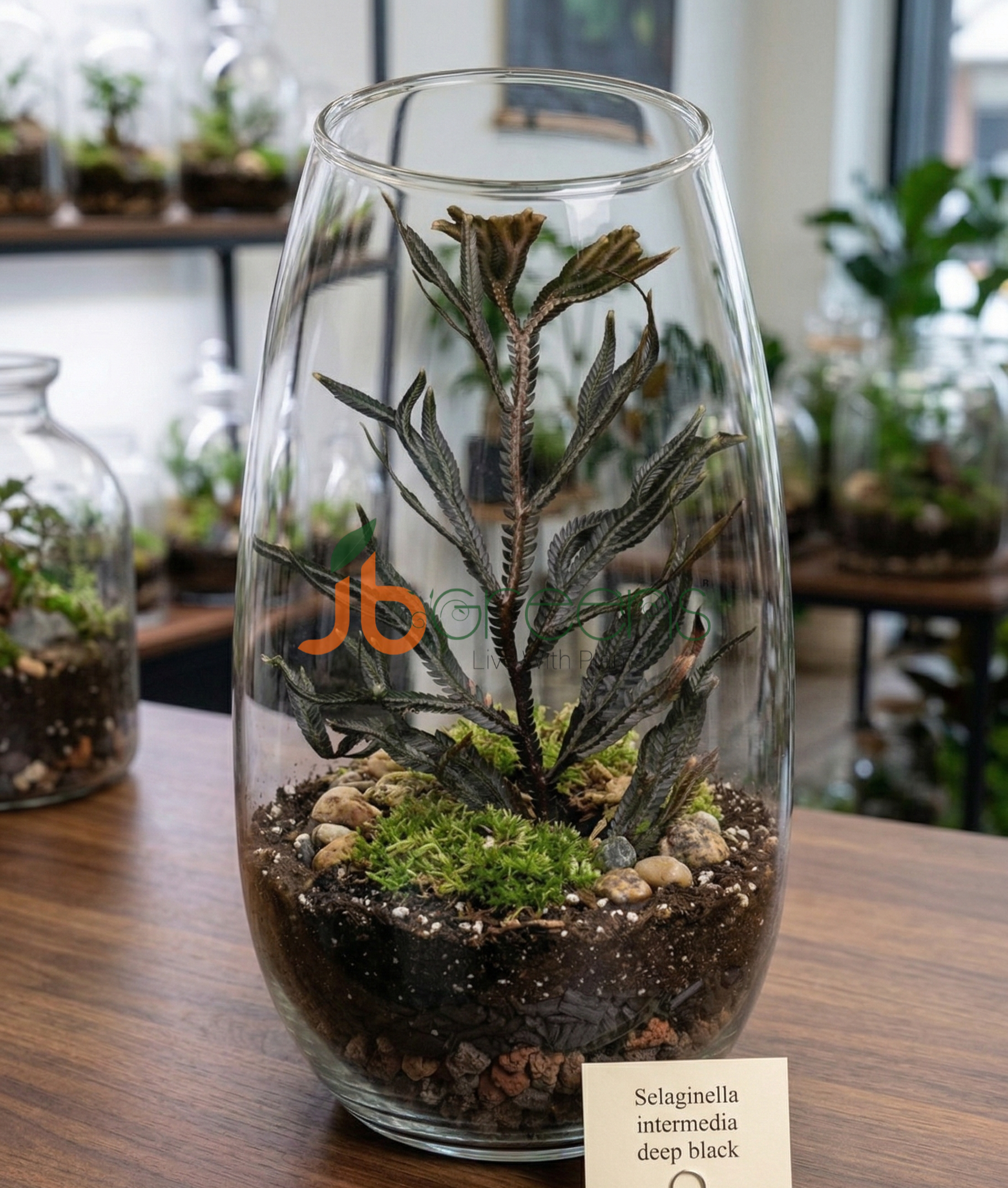
Selaginella intermedia ‘Deep Brown’ – Rare Dark-Foliage Tropical Spikemoss
A Living Miniature Rainforest Canopy in Rich Chocolate & Bronze
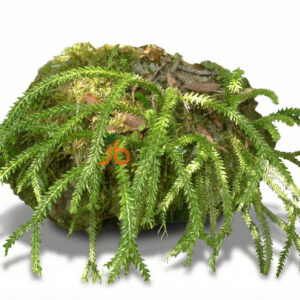
Elevate your terrarium or rare plant collection with Selaginella intermedia ‘Deep Brown’—an extraordinary, collector-grade tropical spikemoss prized for its moody, deep chocolate-brown to dark bronze foliage and intricate, fern-like architecture. Unlike standard green spikemosses, this rare dark form creates instant visual drama, offering a velvety, shadowed backdrop that makes bright green mosses, jewel orchids, and miniature ferns pop.
Grown with care at our Bengaluru nursery, Selaginella intermedia ‘Deep Brown’ is a must-have centerpiece for closed terrariums, paludariums, and bioactive rainforest enclosures.
Quick Botanical Snapshot
| Feature | Details |
| Scientific Name | Selaginella intermedia (Blume) Spring (‘Deep Brown’ Form) |
| Common Name | Deep Brown Spikemoss / Dark Lesser Clubmoss |
| Family | Selaginellaceae (Lycophytes / Fern Allies) |
| Life Cycle | Evergreen Herbaceous Perennial (Non-seed vascular plant) |
| Native Region | Tropical Rainforests of South & Southeast Asia |
| Mature Size | Compact, 10–20 cm tall (spreading via creeping rhizomes) |
| Ideal Setup | Closed Terrariums, Paludariums, Vivariums, High-Humidity Cabinets |
| Difficulty Level | Moderate (Easy once stable humidity is provided) |
Taxonomy, Family & Discovery
-
Plant Family: Belongs to Selaginellaceae, an ancient family of vascular, non-flowering plants known as lycophytes or “fern allies,” whose lineage dates back over 300 million years. Although commonly called spikemoss, it is not a true moss—it possesses true vascular tissues.
-
Who Found & Named This Species: The species was first scientifically described in 1828 by the renowned German-Dutch botanist Carl Ludwig Blume as Lycopodium intermedium (published in Enumeratio Plantarum Javae). In 1843, German-Belgian botanist Antoine Frédéric Spring reclassified the species into its current genus, formally naming it Selaginella intermedia (Bulletins de l’Académie Royale des Sciences et Belles-Lettres de Bruxelles).
-
Life & Reproduction: Selaginella intermedia is a long-lived herbaceous perennial. Rather than producing flowers or seeds, it reproduces naturally through two types of microscopic spores (heterospory—producing both megaspores and microspores) housed in tiny terminal cones called strobili, and spreads vegetatively through creeping stems and rhizomes.
Natural Habitat – Where It Is Normally Found
In the wild, Selaginella intermedia is native to the lush, shaded understories of tropical rainforests across India, Myanmar, Thailand, Vietnam, Peninsular Malaysia, Singapore, Borneo, Sumatra, Java, Sulawesi, Maluku, and the Philippines. It thrives terrestrially on damp forest floors, mossy embankments, and shaded, humid streamsides where sunlight is heavily filtered by the dense canopy above.
What Makes ‘Deep Brown’ Special? (Features & Speciality)
-
Captivating Dark Coloration: Unlike the common green variety, this rare form develops rich, deep brown, bronze, and near-black hues—often accented with delicate, lighter-toned fresh growth tips.
-
Miniature Tree-Like Architecture: Individual stems grow sub-erect to ascending and branch out symmetrically at the top into tiny, lace-like “crowns,” mimicking a miniature prehistoric forest.
-
Velvety Micro-Texture: Its finely arranged, overlapping scale-like leaves create a soft, plush visual texture that elevates any botanical scape.
-
Dynamic Foliage Response: Its coloration responds subtly to its environment—under ideal shaded conditions with balanced nutrition, its deep brown tones intensify dramatically.
How to Identify Selaginella intermedia ‘Deep Brown’
-
Growth Habit: Look for a creeping ground-level rhizome sending up sub-erect, branching stems (10–20 cm) that fan out into symmetrical, fern-like fronds.
-
Scale-Like Microphylls: Tiny, overlapping leaves arranged neatly along delicate stems, each bearing a microscopic basal outgrowth called a ligule (a defining hallmark of Selaginella).
-
Rhizophores: Slender, leafless, aerial prop-like structures that grow downward from the stems and sprout fine roots upon contacting moist substrate.
-
Distinctive Coloration: Deep chocolate-brown to dark bronze foliage (note: if exposed to overly harsh light or nutrient depletion, the plant may shift toward greener tones).
Complete Care Guide
1. Lighting Requirements
-
Ideal: Low to moderate indirect light or soft, filtered LED terrarium lighting.
-
Avoid: Direct sunlight, which rapidly scorches its delicate foliage and washes out its deep brown pigmentation.
2. Humidity Requirements
-
Ideal Range: 70% – 100% relative humidity.
-
High, stable humidity is non-negotiable for this species. Dry indoor air or AC/heater drafts will quickly cause the delicate tips to crisp and curl. It performs best in enclosed glass terrariums, paludariums, or humidity-controlled plant cabinets.
3. Watering Requirements
-
Keep the growing medium consistently and evenly moist at all times—never allow it to dry out completely, as even brief dehydration can cause rapid dieback.
-
Avoid stagnant, waterlogged conditions. Use filtered, RO, or rainwater to prevent mineral buildup on the delicate foliage. Gentle misting helps maintain leaf turgor and ambient humidity.
4. Temperature
-
Thrives in stable, warm tropical temperatures between 18°C and 26°C (up to 28°C with high humidity). Protect from cold drafts and sudden temperature swings.
5. Potting & Recommended Growing Media
Selaginella intermedia requires a moisture-retentive yet airy, organic-rich substrate that holds steady dampness without suffocating its fine root system.
-
Recommended Media from JB Greens: Pair this plant with our Fern Potting Mix by JB Greens—crafted specifically for moisture-loving ferns, mosses, and rainforest understory species. For custom terrarium builds, you can also blend it with a touch of sphagnum moss, fine bark, and horticultural charcoal over a 2 cm drainage layer (LECA or gravel).


Reviews
There are no reviews yet.