
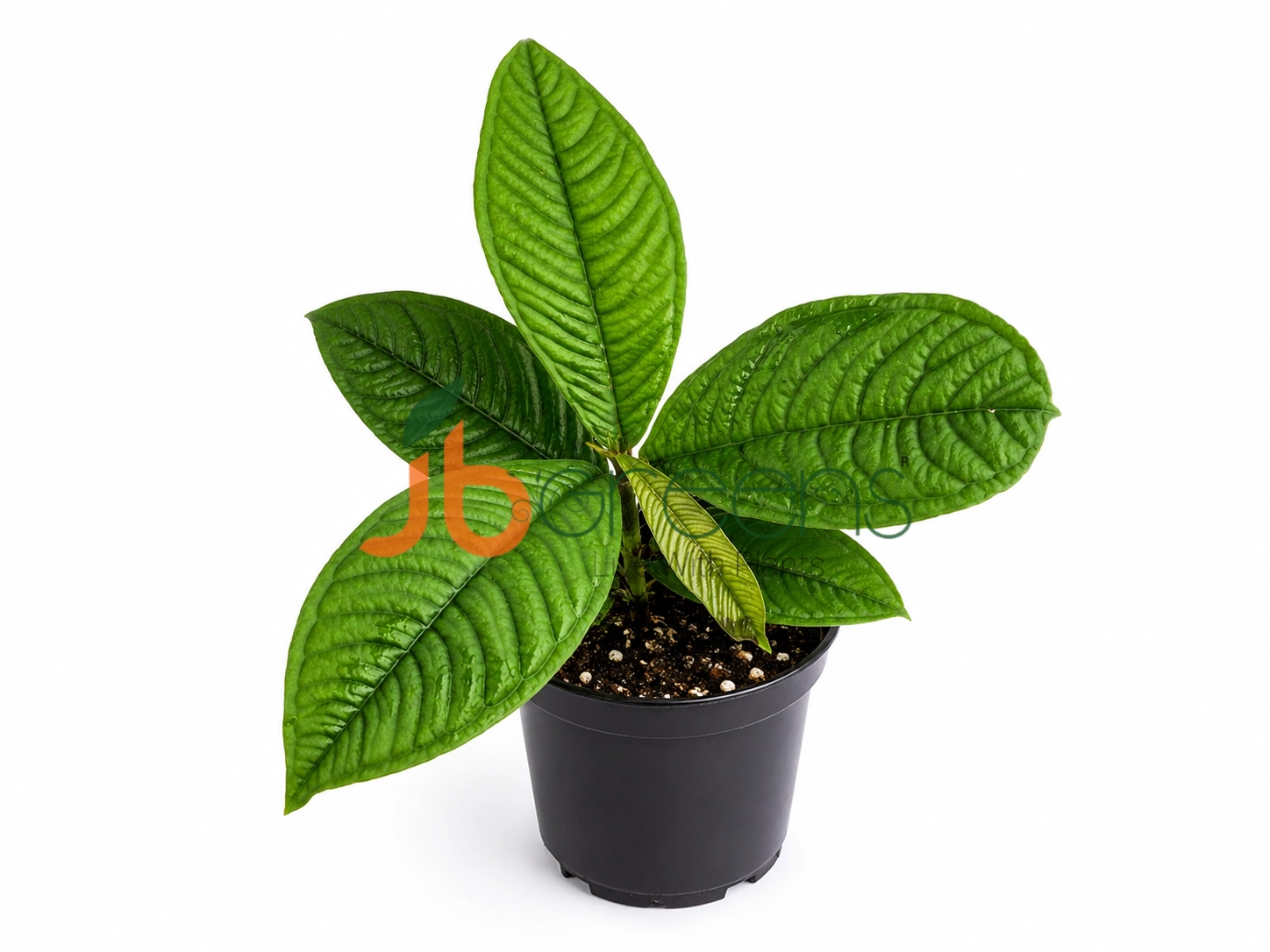
Syzygium jiewhoei is a relatively new, small‑to‑medium tree in the Myrtaceae (clove‑family) known for its lush foliage, striking bark, and showy, nectar‑rich flowers that arise directly from the trunk and branches. Below is a consolidated, practical overview tailored for cultivation and care.
Plant description
-
Growth habit: It grows as an upright, single‑trunked tree with a broad, conical crown; typical mature height is around 8–9 m, making it suitable for small‑scale ornamental plantings rather than street‑tree use.
-
Bark and trunk: The bark is thin, papery, and tends to peel in patches, usually grayish‑brown, giving an interesting, somewhat “exfoliating” texture as the tree ages.
-
Leaves: The leaves are large, elongated, and often described as reaching up to about 1 m in length on wild specimens, with a strong, rectangular‑veined texture and a glossy green surface. Young leaves can show a purplish or reddish tint before maturing to solid green; they are arranged opposite and often appear in neat, two‑rowed patterns along the stems.
-
Flowers and fruit:
-
Flowers are white, borne in dense clusters directly on older branches and trunk (cauliflorous), producing copious nectar for several days and attracting bees and other pollinators.
-
Fruits are small, berry‑like, and often described as salmon‑pink to deep‑purple when mature, with a slightly sour taste; they are appreciated more for ornamental and wildlife value than for commercial fruiting.
-
Growing conditions
-
Climate:
-
It is a true tropical lowland species, thriving in warm, humid conditions with little to no frost risk.
-
Optimal temperature range is broadly in the 20–30 °C band, with appreciable growth slowdown if temperatures regularly fall toward the lower teens or below.
-
-
Light:
-
In its native habitat it often occurs as an understory or sub‑canopy tree, so it prefers bright, filtered light or partial shade.
-
Avoid harsh, all‑day direct sun, especially in hot climates, as this can scorch leaves; semi‑shaded spots or dappled‑sun positions work well.
-
-
Humidity:
-
Appreciates high ambient humidity (roughly 60–80 %), similar to tropical rainforest conditions.
-
In drier or indoor settings, regular misting, a humidity tray, or a small humidifier can help prevent leaf margin browning and leaf‑tip burn.
-
Soil and watering
-
Soil:
-
Prefers a well‑drained, fertile mix rich in organic matter, such as a high‑quality loam or a custom potting blend with compost, coconut coir, and perlite or coarse sand.
-
It is tolerant of a range of soil types as long as drainage is good; it naturally occurs in alluvial and river‑bank‑like soils, so avoiding heavy, water‑logged clay is important.
-
-
Watering:
-
Keep the soil consistently moist but never soggy; the motto is “moist, not waterlogged.”
Allow the top layer to dry slightly between waterings, rather than watering on a rigid schedule; overwatering or prolonged saturation can lead to root rot.
-
Adaptability and cultivation notes
-
Landscape vs. container:
-
In the ground, it develops into a typical small to medium tree with a broad crown, suitable for shaded gardens, courtyards, or as a feature specimen where space allows.
-
In large containers, growth is slower and more compact, but the plant can still thrive; expect somewhat smaller leaf size and a more shrubby‑tree form.
-
-
Frost and cold tolerance:
-
It is not suited to frost or prolonged cool‑season climates; even brief exposure to temperatures near or below 10 °C can cause leaf drop or stalled growth.
Airflow and spacing:
-
Good air circulation helps reduce the risk of fungal issues on foliage, especially in humid, enclosed settings.
-
If planting in a group, space trees a few meters apart to allow for their conical spread and to avoid crowding the lower canopy.
-
Care and maintenance
-
Fertilizing:
-
Use a balanced, slow‑release or organic fertilizer formulated for tropical trees or ornamentals, applied in the warm season (spring to early autumn) when the plant is actively growing.
-
Avoid heavy, high‑salt synthetic fertilizers on light or sandy soils; instead, build soil fertility gradually with compost and organic amendments.
-
-
Pruning:
-
Prune primarily to shape the crown, remove any dead or crossing branches, or to restrict height if grown in a confined space.
-
Avoid heavy pruning during cooler or low‑light periods; the best time is in the warm, humid months when the plant can recover quickly.
-
-
Pests and diseases:
-
In humid tropical settings, watch for scale insects, mealybugs, or spider‑mites on the undersides of leaves; these can usually be managed with horticultural oil or insecticidal soap applications.
-
Root rot from poor drainage and anthracnose‑type leaf spots can occur in constantly wet conditions; improving drainage and airflow usually reduces severity.
-
Propagation
-
By seed:
-
Fresh seeds generally have the best germination; they are sown in a moist, well‑aerated seed mix and kept warm and humid.
-
A light covering of soil and consistent moisture (often aided by a clear plastic cover or humidity dome) can help; germination may take several weeks to a few months.
-
-
By cuttings:
-
Semi‑ripe or softwood cuttings treated with rooting hormone can be struck in a warm, humid, well‑drained medium (e.g., perlite–coconut mix); mist systems or sealed propagators improve success.
-


Reviews
There are no reviews yet.