
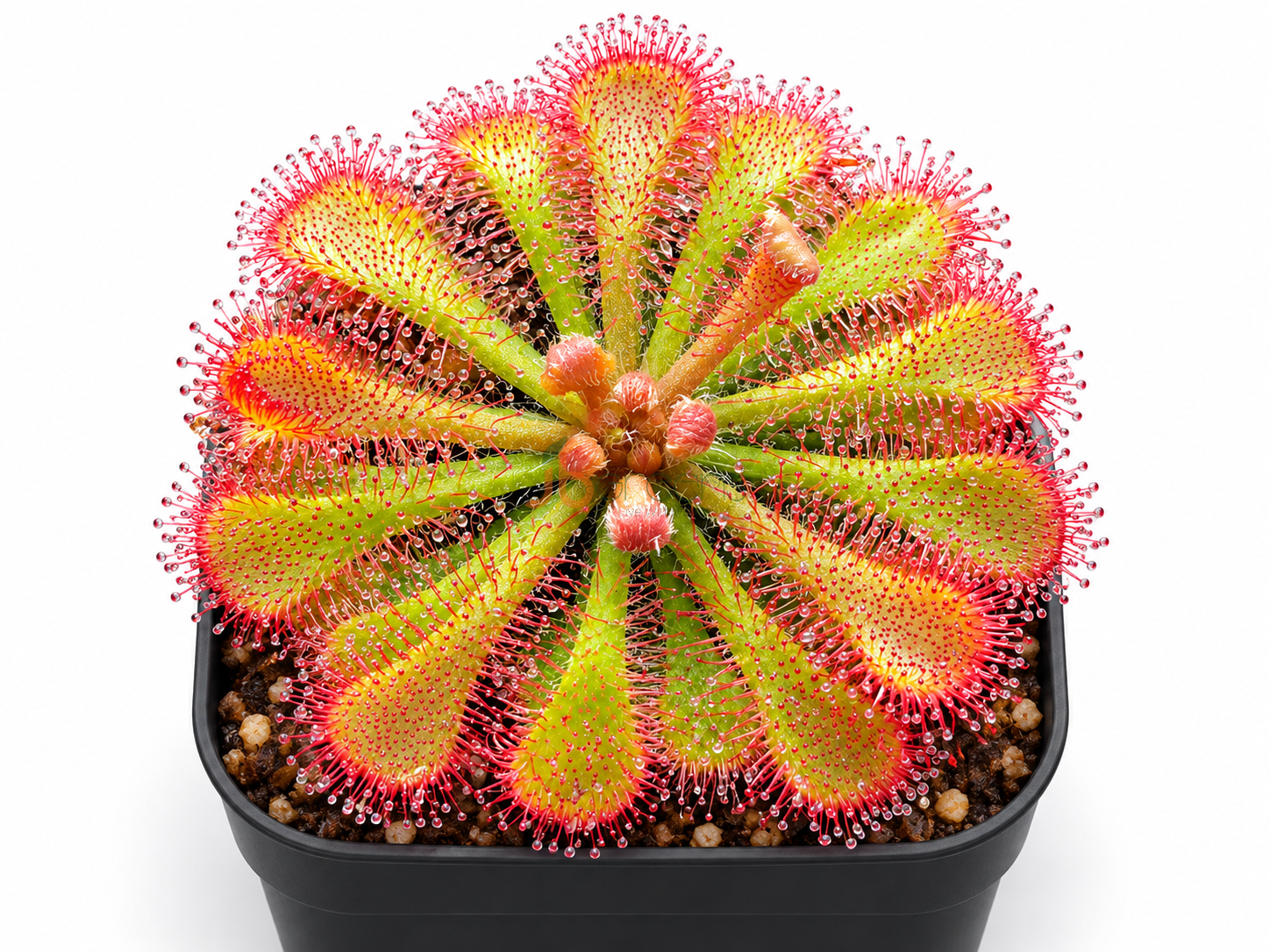
Bring a touch of captivating natural wonder to your collection with Drosera tokaiensis, an exquisite carnivorous plant that combines evolutionary fascination with effortless elegance. Endemic to Japan, this stunning sundew is a natural stable allopolyploid hybrid originating from a cross between Drosera rotundifolia and Drosera spatulata. Adorned with delicate, spoon-shaped leaves covered in glistening, jewel-like glandular tentacles, it catches and digests tiny insects using sparkling, sticky dew drops that shine brilliantly under the light.
Key Features & Speciality
-
The Glistening Trap: Each tentacle is tipped with a clear, viscous droplet of mucilage that lures prey with a scent resembling nectar, acting as an adhesive trap.
-
Fascinating Origin: Unlike ordinary hybrids that remain sterile, Drosera tokaiensis has stabilized into a self-fertile, true-breeding species.
-
Prolific Self-Pollinator: It produces tall, slender scapes carrying dainty pink or light purple flowers that generously yield abundant, easily sprouted seeds.
-
Stunning Coloration: Under high-intensity lighting, its green rosettes blush into striking shades of deep bronze, crimson, and vibrant red.
Identification Methods
Distinguishing Drosera tokaiensis from its close relative Drosera spatulata can sometimes be tricky due to overlapping leaf shapes. Positive identification is best achieved through:
-
Leaf Morphology: Leaves display an intermediate form—broader than typical D. spatulata but elongated compared to D. rotundifolia.
-
Microscopic Analysis: Examination of Biseriate Glandular Trichomes (BGTs) and chromosome counts (allohexaploid with 60 chromosomes).
-
Inflorescence & Seed Production: Highly fertile upright flower stalks with self-pollinating pink blooms.
Habitat & Distribution
In nature, Drosera tokaiensis is primarily found in the Tokai region of central Honshu, Japan, thriving in damp wetlands, acidic bogs, and moist sandy soils. Because its natural marshland habitats have faced environmental pressures, cultivating this plant at home plays a wonderful role in appreciating and preserving a rare botanical masterpiece.
Comprehensive Care Guide
1. Lighting Requirements
-
Bright Light to Full Sun: To achieve rich red coloration and robust health, provide intense light.
-
Indoor Cultivation: Thrives wonderfully under strong LED grow lights or T5/T8 fluorescent setups for a 14–16 hour photoperiod.
2. Watering Requirements
-
The Tray Method (Crucial): Never let carnivorous plants dry out. Keep the pot sitting in 1 to 2 inches of pure water at all times.
-
Water Quality Matters: Strictly use distilled water, reverse osmosis (RO) water, or collected rainwater. Tap water contains mineral solutes and salts that will quickly burn and kill carnivorous roots.
3. Humidity & Temperature
-
Humidity: Enjoys moderate to high humidity (60% to 90%), though it adapts remarkably well to standard household room humidity levels if kept thoroughly wet at the roots.
-
Temperature: Thrives in subtropical conditions ranging between 10°C to 30°C (50°F to 85°F), tolerating seasonal shifts gracefully.
4. Nutrient Requirements
-
Zero Soil Fertilizers: Never use standard chemical fertilizers or fertilize the soil. Carnivorous plants have evolved to capture their own nutrients via insects.
-
Feeding: If grown indoors without access to bugs, you can occasionally feed the tentacles tiny amounts of diluted organic plant tonics or freeze-dried bloodworms once every few weeks.
5. Potting & Media
-
Nutrient-Free Mix: Standard potting soil contains rich fertilizers that are toxic to sundews. Always plant them in pure long-fibered sphagnum moss or a 1:1 mix of nutrient-free peat moss and horticultural perlite/silica sand.
6. Repotting
-
Frequency: Repot every 1 to 2 years during early spring or its mild resting phase to refresh degraded moss or media.
-
Process: Handle the delicate root system gently, rinse media components beforehand, and immediately place back into the tray-watering system.
Use in Terrarium and Paludarium Setups
-
Drosera tokaiensis makes an exceptional centerpiece for open-air terrariums, highland carnivorous plant bowls, and customized paludariums.
-
Because it stays compact (3–8 cm across), it will not crowd out companion plants like Pinguicula (butterworts) or smaller mosses, provided it receives the high lighting and pure wet substrate conditions it demands.
Elevate Your Setup with www.jbgreens.com Essentials
To give your Drosera tokaiensis the ultimate ecosystem to thrive, pair your plant purchase with professional-grade supplies available right here at www.jbgreens.com:
-
🌿 JB Greens Premium Carnivorous Potting Media: Specially blended, ultra-pure, unfertilized long-fibered sphagnum moss and silica-sand mixes designed specifically to replicate natural bog conditions without root burn.
-
💧 JB Greens Specialized Plant Tonics & Micro-Nutrient Feeds: Carefully formulated foliar enhancements meant to safely boost vigor, dew production, and rich coloration for your collection without harming sensitive root structures.
| Plant group | Carnivorous plants |
|---|---|
| Genus | Drosera |
| Botanical family | Droseraceae |
| Growing environment | Indoor growing |
| Light | Full sun |
| Humidity | High humidity |
Only logged in customers who have purchased this product may leave a review.
Related products
-
ABOUT THE PLANT: Common name: Acranthera Sp. Red Metallic Indonesia endemic plant The photo is representative Plant is healthy and in the good condition It is sold per plant
Add to cart -
ABOUT THE PLANT : Indonesia endemic plant The photo is representative Plant is healthy and in the good condition It is sold per plant
Read more -
-
ABOUT THE PLANT: Indonesia endemic plant from Kalimantan The photo is representative Plant in the good condition and healthy 3-4 leaves It is sold per plant Argostemma is a genus of flowering plants in the family Rubiaceae. It can be found in (sub)tropical Asia and western and west-central tropical Africa. Kingdom: Plantae Clade: Tracheophytes Clade: …
Add to cart


Products
-
 Dionaea muscipula 'Fused Tooth'
Original price was: ₹2,100.00.₹1,800.00Current price is: ₹1,800.00.
-
 Ceratostylis Javanica
Original price was: ₹1,600.00.₹1,400.00Current price is: ₹1,400.00.
-
 Pinanga Ridleyana
Original price was: ₹3,900.00.₹3,250.00Current price is: ₹3,250.00.
-
 Fissistigma Sp
Original price was: ₹4,100.00.₹3,800.00Current price is: ₹3,800.00.
-
 Solanum Evolvulifolium
Original price was: ₹1,800.00.₹1,300.00Current price is: ₹1,300.00.


Reviews
There are no reviews yet.