
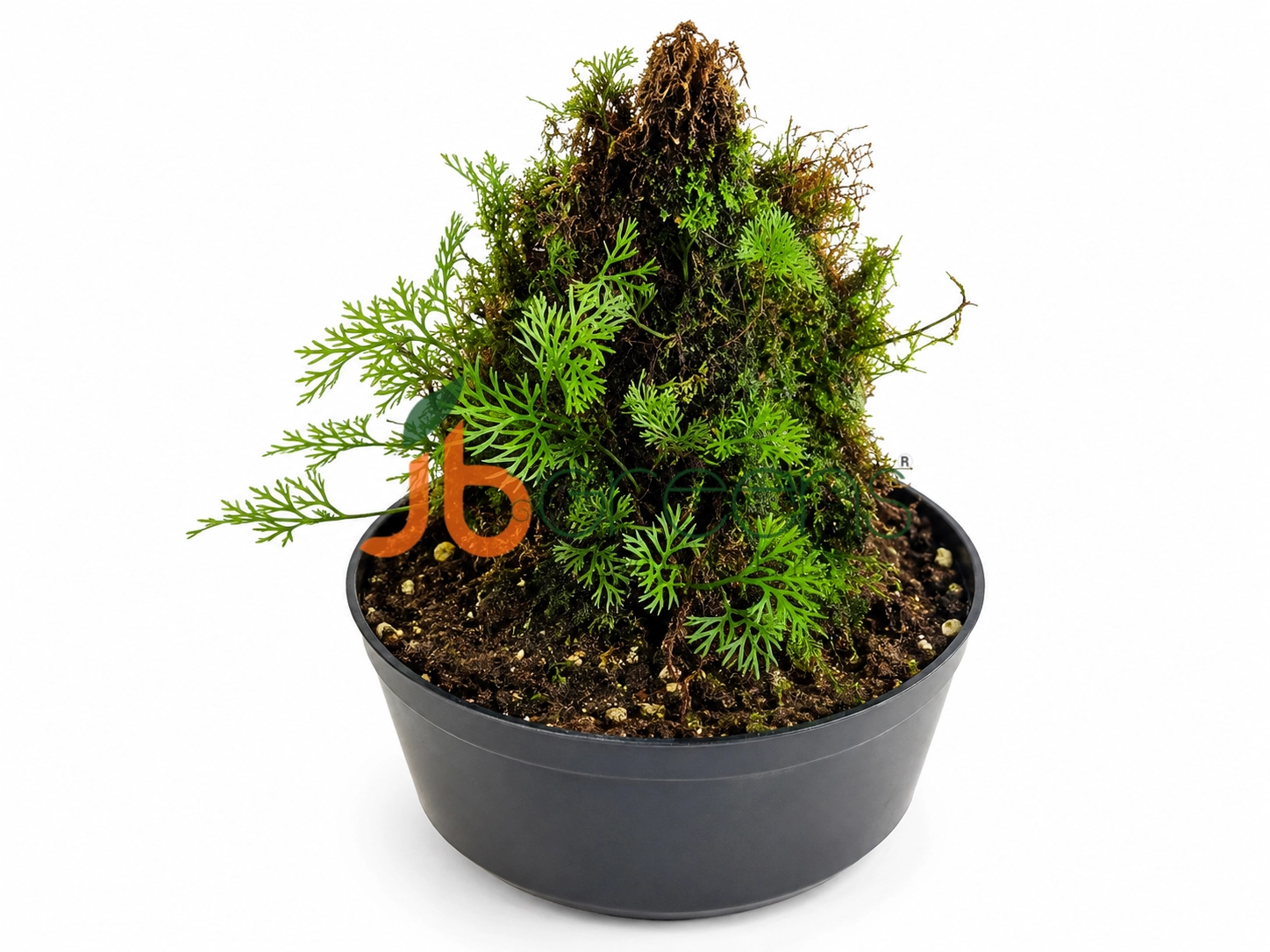
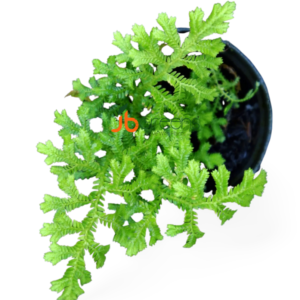
Deville Paruvala (usually treated botanically as Davallia parvula, though trade names may differ) is a small, fine‑textured epiphytic fern prized for its compact, neat growth and soft green foliage. It is commonly used in terrariums, vivariums, or mounted displays rather than as a large garden or pot plant.
Overall description
-
Growth habit: Forms a creeping, low‑growing mat via thin, wiry rhizomes that creep along the surface of bark, rock, or substrate rather than bundling into a single crown.
-
Fronds: Small, triangular‑deltoide, multiple‑pinnate fronds, usually only around 0.5–3.5 cm long, giving a delicate, lacy appearance.
-
Rhizome surface: The rhizome is covered in fine reddish‑brown or coppery scales, which help anchor the plant and give it a slightly fuzzy look.
Light and adaptability
-
Light preference: Does best in medium to bright, filtered or dappled light; it can tolerate somewhat lower light but will grow more slowly and may become leggy.
-
Sun tolerance: Avoid direct, harsh sunlight; it prefers indirect or shaded‑light conditions, such as under a canopy, inside a vivarium, or on a shaded shelf.
-
Adaptability: Fairly adaptable to controlled‑environment settings (terrariums, vivariums, glass enclosures) but can be sensitive if humidity or moisture are suddenly changed or if the leaves are kept constantly wet.
Watering and humidity
-
Watering: Keep the substrate or mount consistently moist but not waterlogged; allow the surface to dry slightly between waterings rather than letting it stay soggy.
-
Leaf moisture: Avoid leaving water sitting on the fronds; many growers report it prefers high humidity with indirect misting rather than direct sprays that soak the leaves.
-
Humidity: Thrives in elevated humidity; in drier air, it responds well to a humid microclimate such as a closed or semi‑closed terrarium, or placement near a humidifier or damp pebble tray.
Temperature and microclimate
-
Temperature range: Prefers warm, stable temperatures; avoid strong drafts, rapid temperature swings, and prolonged cold bursts.
Night temperatures: Socially it dislikes very cold nights; it performs best when nighttime lows remain above the lower end of its preferred range and do not drop abruptly.
-
Microclimate: Because of its epiphytic nature, it adapts well to vertical or semi‑vertical surfaces (cork, wood, mesh) where air can move around the rhizome while moisture is provided to the support.
Growing media and mounting
-
Epiphytic preference: Naturally grows on bark, rock, or other porous surfaces, so it is best not treated as a purely terrestrial pot‑plant in dense soil.
-
Mounting substrates: Thrives on cork bark, tree‑fern plaques, or similar natural‑style mounts, with a thin layer of moisture‑retentive but airy medium (e.g., sphagnum or fine bark mix) around the rhizome.
-
Potted culture (if used): If kept in a pot, use a very open, well‑draining mix rich in organic matter so the base stays moist but never soupy; the plant will still appreciate higher humidity around the foliage.
Growth rate and behavior
-
Speed: Generally slow to moderate growing, especially in lower‑light or lower‑humidity conditions; it tends to creep outward in a neat mat rather than shoot up quickly.
-
Behavior: Often stays compact and non‑invasive, making it suitable for small enclosures, foregrounds, or as a “mat‑forming” accent around other plants or hardscape features.
Only logged in customers who have purchased this product may leave a review.
Related products
-
ABOUT THE PLANT: Indonesia endemic plant The photo is representative Plant in the good condition and healthy It has 3-4 leaves It is sold per plant Davallia (deersfoot fern, hare’s foot fern, shinobu fern, rabbit foot fern, ball fern) is a genus of about 40 species of fern. The native range of this species is …
Add to cart -
Davallia repens is a striking epiphytic fern prized for its lush, triangular fronds and fuzzy, creeping rhizomes that give it a distinctive, rabbit’s-foot-like appearance. Native to tropical regions, it forms compact clumps with leaves typically reaching 5 inches long and 2-3 inches wide under optimal cultivation. Detailed Description This medium-sized fern features dense, evergreen fronds …
Add to cart

Products
-
 Begonia Maloh
Original price was: ₹1,800.00.₹1,550.00Current price is: ₹1,550.00.
Begonia Maloh
Original price was: ₹1,800.00.₹1,550.00Current price is: ₹1,550.00.
-
 Sauvegasia Serrata
Original price was: ₹2,100.00.₹1,550.00Current price is: ₹1,550.00.
Sauvegasia Serrata
Original price was: ₹2,100.00.₹1,550.00Current price is: ₹1,550.00.
-
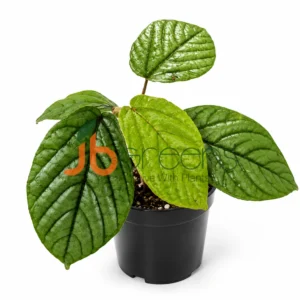 Pterisanthes Silver
Original price was: ₹2,400.00.₹1,800.00Current price is: ₹1,800.00.
Pterisanthes Silver
Original price was: ₹2,400.00.₹1,800.00Current price is: ₹1,800.00.
-
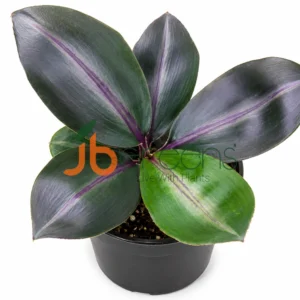 Geogenanthus Rhizanthus
Original price was: ₹2,400.00.₹1,800.00Current price is: ₹1,800.00.
Geogenanthus Rhizanthus
Original price was: ₹2,400.00.₹1,800.00Current price is: ₹1,800.00.
-
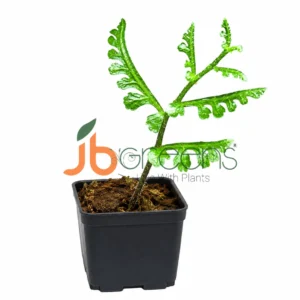 Teratophyllum Sp.Ager
Original price was: ₹1,400.00.₹1,200.00Current price is: ₹1,200.00.
Teratophyllum Sp.Ager
Original price was: ₹1,400.00.₹1,200.00Current price is: ₹1,200.00.



Reviews
There are no reviews yet.