
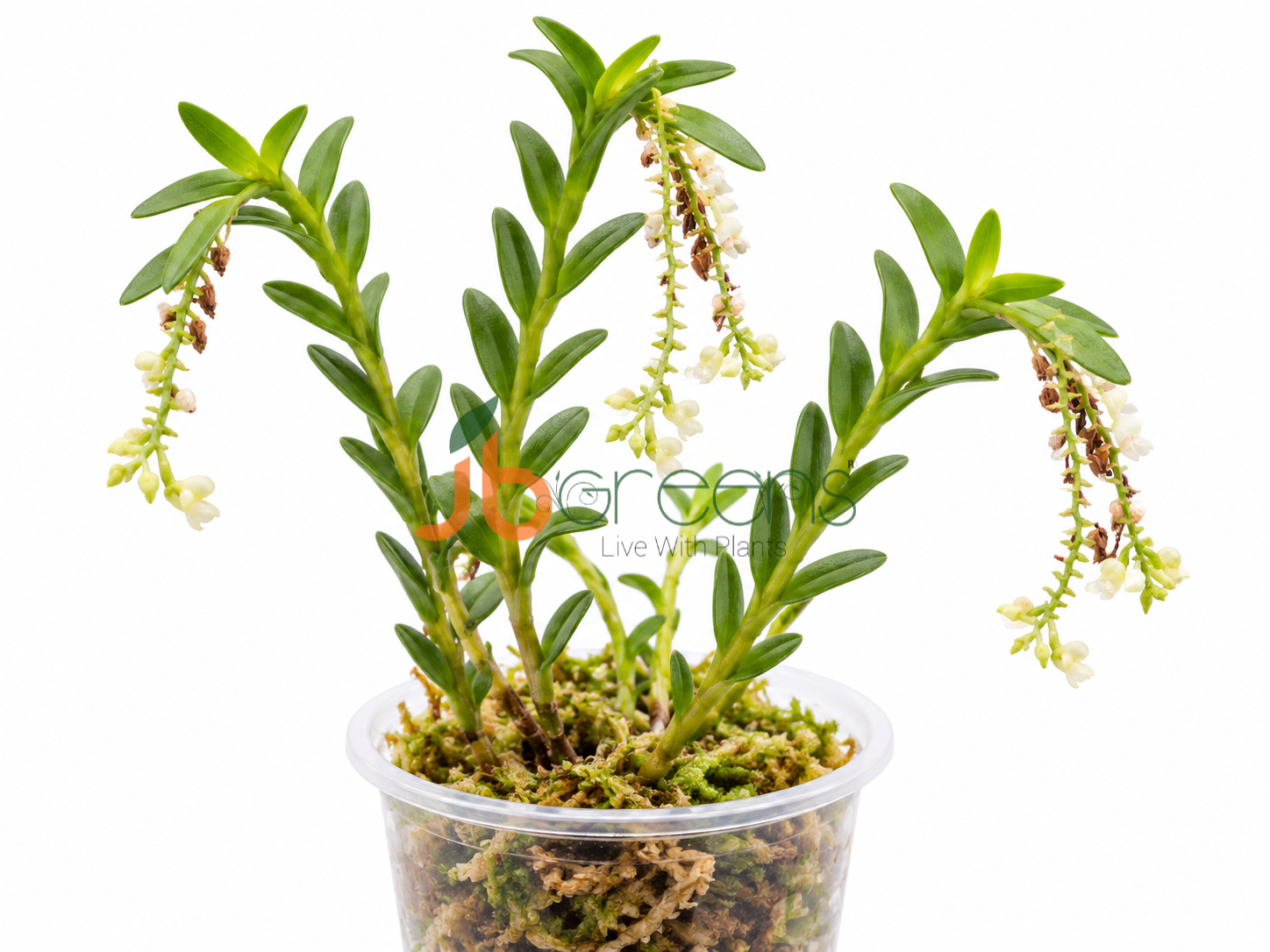
Podochilus khasianus is a small, delicate orchid with a compact, moss‑like growth habit and very fine‑scale foliage and flowers. Below is a detailed yet practical overview of its description, adaptability, culture, and growing conditions, tailored for a specialist grow‑op rather than a casual hobbyist.
Morphology and plant habit
-
Growth form: Monopodial, tufted and epiphytic, forming small, dense clumps rather than long‑running vines; stems are short, sub‑terete (almost cylindrical but slightly flattened), and closely packed with many leaves.
-
Leaf structure: Leaves are numerous, distichously arranged (in two opposite rows), narrowly oblong to narrowly oblong‑lanceolate, somewhat fleshy, and often slightly curved or falcate. Each leaf is articulated at the base and narrows into a tubular, amplexicaul sheath that partly wraps the stem.
-
Flowering: Inflorescences are short, terminal or lateral, carrying only a few tiny flowers (usually 2–4). The flowers themselves are minute, typically white or greenish‑white, borne on a compact raceme with small ovate‑lanceolate bracts.
Environmental adaptability
-
Temperature range: Hot to cool conditions; it tolerates warm humid summers but can also persist in cooler, subtropical montane settings.
-
Humidity and air movement: Prefers high ambient humidity (60–80%) with gentle air movement, because its small size and dense foliage make it prone to fungal spots if stagnant and over‑wet.
-
Light demands: Best suited to bright, filtered light or partial shade, similar to species adapted to forest‑edge or streamside habitats; strong direct midday sun tends to scorch leaf tips and desiccate the fine foliage.
Growing conditions and substrate
-
Culture type: Naturally an epiphyte, so it grows on trees or in well‑aerated, loose media rather than dense soil.
-
Preferred mount/media:
-
On cork or tree fern plaques: Secure the tiny clump with thin, decomposable fiber (e.g., cotton or fine sphagnum) and allow fine‑root‑to‑surface contact; avoid heavy wire or nylon that can constrict growth.
-
In blocks or very open pots: Use extremely chunky mixes—fine to medium bark, coconut chips, or charcoal with minimal fines—so that air can penetrate and the media dries quickly after watering.
-
-
Elevation context: In the wild, it occurs in forests at moderate elevations; under cultivation, it adapts well to low‑elevation greenhouses or indoor setups if temperature and humidity are managed carefully.
Water and feeding
-
Watering pattern: Requires frequent but brief wetting, with the mounted or potted mass allowed to dry slightly between irrigations. For mounted plants, misting or light overhead showers twice daily in hot weather is usually effective; in pots, water only when the surface of the chunky media is nearly dry.
-
Hard‑water considerations: Avoid heavy, calcareous or very alkaline water, as the fine roots are sensitive to salt buildup; use rainwater, filtered water, or low‑EC irrigation whenever possible.
-
Fertilization: Low‑strength, complete orchid fertilizer is best; apply at about ¼–½ the label rate with each watering during active growth, then reduce or suspend during cooler resting periods. Occasionally leaching the mount or pot with plain water helps prevent mineral accumulation.
Flowering, dormancy, and long‑term care
-
Seasonality: Typically flowers in the warmer part of the year on short, terminal or lateral inflorescences, with several very small blooms appearing sequentially.
-
Dormancy: Not a strongly dormant species; growth tends to slow rather than stop completely in cooler months, so water and fertilizer should be dialed back but not fully cut off.
-
Long‑term management: Re‑mounting or dividing clumps every 2–3 years keeps the plant healthy by preventing media breakdown and root congestion. When dividing, preserve naturally compact tufts intact rather than unnecessarily shredding the little clumps, as this speeds recovery and reduces stress.
.
| Plant group | Orchids |
|---|---|
| Genus | Podochilus |
| Botanical family | Orchidaceae |
| Light | Bright indirect light, Medium indirect light |
| Humidity | High humidity |
Only logged in customers who have purchased this product may leave a review.
Related products
-
ABOUT THE PLANT: Indonesia aquatic plant The photo is representative Plant is healthy and in the good condition It is sold per plant
Read more -
ABOUT THE PLANT: Indonesia endemic plant from Papua The photo is representative Plant in the good condition and healthy 4-6 leaves It is sold per plant Ardisia is a genus of flowering plants in the family Primulaceae. It was in the former Myrsinaceae family now recognised as the myrsine sub-family Myrsinoideae. They are distributed in …
Read more -
ABOUT THE PLANT: Indonesia endemic plant from Kalimantan The photo is representative Plant in the good condition and healthy 3-4 leaves It is sold per plant Argostemma is a genus of flowering plants in the family Rubiaceae. It can be found in (sub)tropical Asia and western and west-central tropical Africa. Kingdom: Plantae Clade: Tracheophytes Clade: …
Add to cart -
ABOUT THE PLANT: Common name: Acranthera Sp. Kapuas Hulu Indonesia endemic plant The photo is representative Plant is healthy and in the good condition It has 2-3 leaves It is sold per plant
Read more


Products
-
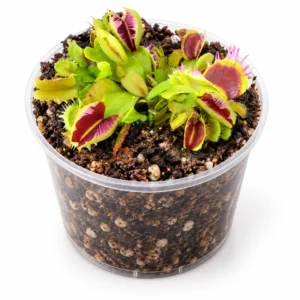 Dionaea muscipula 'Fused Tooth'
Original price was: $29.04.$24.89Current price is: $24.89.
-
 Ceratostylis Javanica
Original price was: $22.13.$19.36Current price is: $19.36.
-
 Pinanga Ridleyana
Original price was: $53.94.$44.95Current price is: $44.95.
-
 Fissistigma Sp
Original price was: $56.70.$52.55Current price is: $52.55.
-
 Solanum Evolvulifolium
Original price was: $24.89.$17.98Current price is: $17.98.


Reviews
There are no reviews yet.